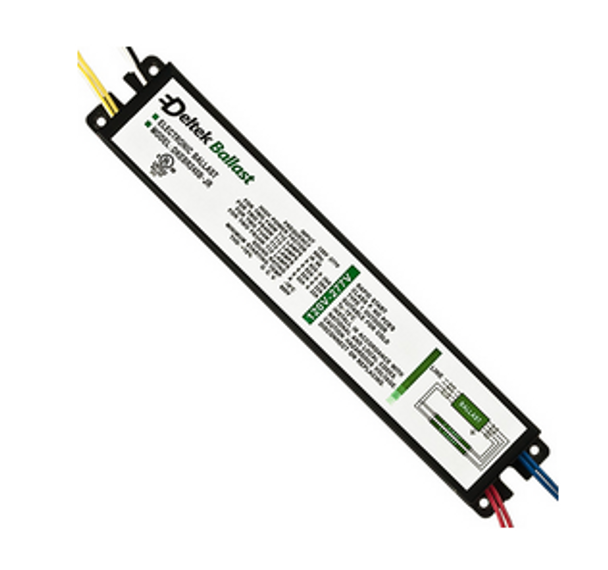
What Are Electronic Ballasts & How Do They Work?
Updated: August 13, 2025
An electronic ballast controls voltage and current for fluorescent lamps and some HID systems. LEDs do not use ballasts: they use LED drivers, except for specific UL Type A retrofit tubes designed to run on an existing electronic fluorescent ballast. For a quick primer on what ballasts and drivers do, see the industry overview from NEMA and the lamp-type guidance in the DLC V5.1 testing rules for linear replacement lamps.
Key benefits of electronic ballasts
Lower energy use: Typical magnetic-to-electronic fluorescent retrofits often deliver ~30–45% system savings, depending on lamp/ballast pairing and ballast factor (see the planning-watts example below for a ~42% case).
Flicker and noise greatly reduced: Electronic ballasts run lamps at high frequency (about 20–60 kHz), which mitigates visible flicker and audible hum. A representative spec is “>42 kHz” on the Advance ICN family (LRC T8 guidance, Advance ICN spec).
Lamp life support: Programmed-start electronic ballasts preheat electrodes before striking the arc, which helps in frequent-switching applications such as occupancy-sensor control (Philips/Advance ballast fundamentals).
➡️ Ready to replace failed fluorescent gear? Browse Revco’s electronic fluorescent ballasts.
How much energy can you save?
Baseline: Magnetic fluorescent systems operate at 60 Hz and have higher ballast losses. Electronic systems drive lamps at high frequency with lower losses (LRC overview).
Example (two-lamp troffers, planning values):
Existing: 200 fixtures with 2-lamp F40T12 + magnetic gear at 97 W per fixture.
Retrofit: 2-lamp F32T8 + electronic at 56.32 W per fixture.
(Representative Ameren Illinois “Typical Lighting Wattages” planning table.)
Annual savings (3,000 hours):
200 × (97 − 56.32) W × 3,000 h = 24,408 kWh avoided.
At $0.15/kWh, that is roughly $3,661/yr. Adjust the rate to match your utility bill.
Electronic vs. magnetic: quick comparison
| Feature | Magnetic ballast | Electronic ballast |
|---|---|---|
| Efficiency | Lower | Higher; often ~30–45% system savings in common T12→T8 retrofits |
| Flicker / noise | Common at 60 Hz | Greatly reduced at high frequency |
| Start behavior | Slower | Instant, rapid, or programmed-start options |
| Dimming | Limited | Broad options via dimming ballasts (e.g., 0–10 V families exist) |
(Performance varies by lamp–ballast combination; confirm with manufacturer data such as the Advance ICN family spec.)
A note on LEDs: ballast or driver?
Most LED luminaires use an LED driver, not a ballast. Linear LED tubes come in types:
UL Type A: runs on an existing electronic fluorescent ballast; always check ballast compatibility on the lamp’s spec sheet.
UL Type B: ballast-bypass with internal driver and fixture rewiring.
UL Type C: external driver replaces the ballast, enabling features like 0–10 V dimming.
The DLC policy requires Type A and A/B (dual-mode) lamps to be tested as lamp-plus-ballast systems, while Type C is tested with its external driver (DLC V5.1 testing rules).
Best applications for electronic ballasts
Offices and schools: quiet, stable light improves comfort and reduces visible flicker compared with 60 Hz magnetic systems (LRC advantages).
Warehouses and industrial spaces: choose programmed-start for occupancy-sensor operation and frequent switching (Advance fundamentals).
Maintaining HID gear? Explore Revco’s metal-halide ballasts and high-pressure sodium ballasts.
How to upgrade from magnetic to electronic ballasts
Check compatibility: Match the ballast to your lamp type and count, or confirm that your LED tube is Type A and listed for your specific ballast model (DLC treats Type A/A+B as lamp-plus-ballast systems; see the DLC V5.1 guidance).
Select the right voltage and features: Many electronic ballasts support 120–277 V, and dimming options are available—confirm in the datasheet (e.g., Advance ICN spec).
Upgrade in phases: Start with longest-hour areas for the fastest payback.
Follow installation rules: De-energize, follow the wiring diagram, and add a disconnecting means when required. NEC 2023 410.71 (for indoor locations other than dwellings) requires a disconnect for fluorescent or LED luminaires with double-ended lamps when the ballast or driver can be serviced in place; local adoption and the AHJ govern enforcement (see this NEC 410.71 explainer).
• If you perform ballast-bypass (Type B) or external-driver (Type C) retrofits, follow UL 1598C retrofit-kit instructions and apply the provided re-labeling so the modified luminaire is clearly identified (UL’s overview: Safety compliance of luminaire retrofits).Track results: Log fixture counts, hours, and wattages to validate kWh savings against bills; the planning watts in this article come from Ameren Illinois’ Typical Lighting Wattages guide.
Ready to buy or need help speccing?
Shop ballasts and drivers or ask our counter team for a fast recommendation. If your project includes low-voltage lighting or controls, see our low-voltage transformers as well as LED drivers.
Since 1978, Revco Lighting & Electrical Supply has been helping professionals bring their projects to light literally. As a go-to source for lighting and electrical products across Long Island, NY and nearby areas, we specialize in supporting contractors, builders and industry experts with practical solutions and dependable service. Whether it’s a complex commercial build or a simple residential upgrade, we’re here to make sure you have what you need, when you need it.